Most of the wrong bookings I see start with one short phone call.
“Got a vac truck free Thursday?”
“Yep.”
“Sweet, book it.”
Nobody asks what the job is, where the truck’s parking, what’s in the ground, or where the spoil’s going. Then Thursday rolls around and a big unit turns up at a house with a steep concrete driveway and a carport roof at 2.4 metres. Or a little trailer unit rocks up to a civil job with 40 metres of trench to expose, fills its tank before smoko, and spends the rest of the day driving to the tip and back.
Same story both times. The truck was fine. It was just the wrong truck for that job.
So this is how I’d go about choosing a vacuum excavation truck if I was the one paying for it. It’s not about price, and it’s not about who’s free tomorrow. It’s about matching the gear to the dig.
Work out what you’re actually doing first
Before you ring anyone, get clear on whether this is careful work or volume work.
Careful work is potholing, exposing services, digging around gas or HV, pier holes next to a sewer, a slot across a footpath full of telco. You’re not moving much dirt. You’re moving it slowly and precisely, and the operator matters more than the truck.
Volume work is longer trenches, pits, cleaning out spoil from a bore, or sucking out a big hole where a machine can’t go. Now tank size, suction power and turnaround times start to matter a lot.
Plenty of jobs are a bit of both. That’s fine, but tell whoever you’re booking which part is the bigger job. A crew set up for six potholes across a road reserve is a very different setup to one sucking out 15 cubic metres of trench.
If you’re not sure, think about it this way. If the hard part is not hitting anything, it’s careful work. If the hard part is getting enough dirt out, it’s volume.
Big truck or small truck
People assume bigger is better. It’s not. Bigger is better when you need it, and a pain in the backside when you don’t.
Roughly speaking, you’re looking at three sizes:
- Trailer or small units. Small tank, lighter, easier to park, can get into places a truck can’t. Good for a handful of potholes, residential jobs, a few pier holes, meter and valve exposure. They fill up quick though.
- Mid-size trucks. The workhorse for most NDD around town. Enough tank for a decent day of potholing or a short trench, still small enough for most streets and plenty of driveways.
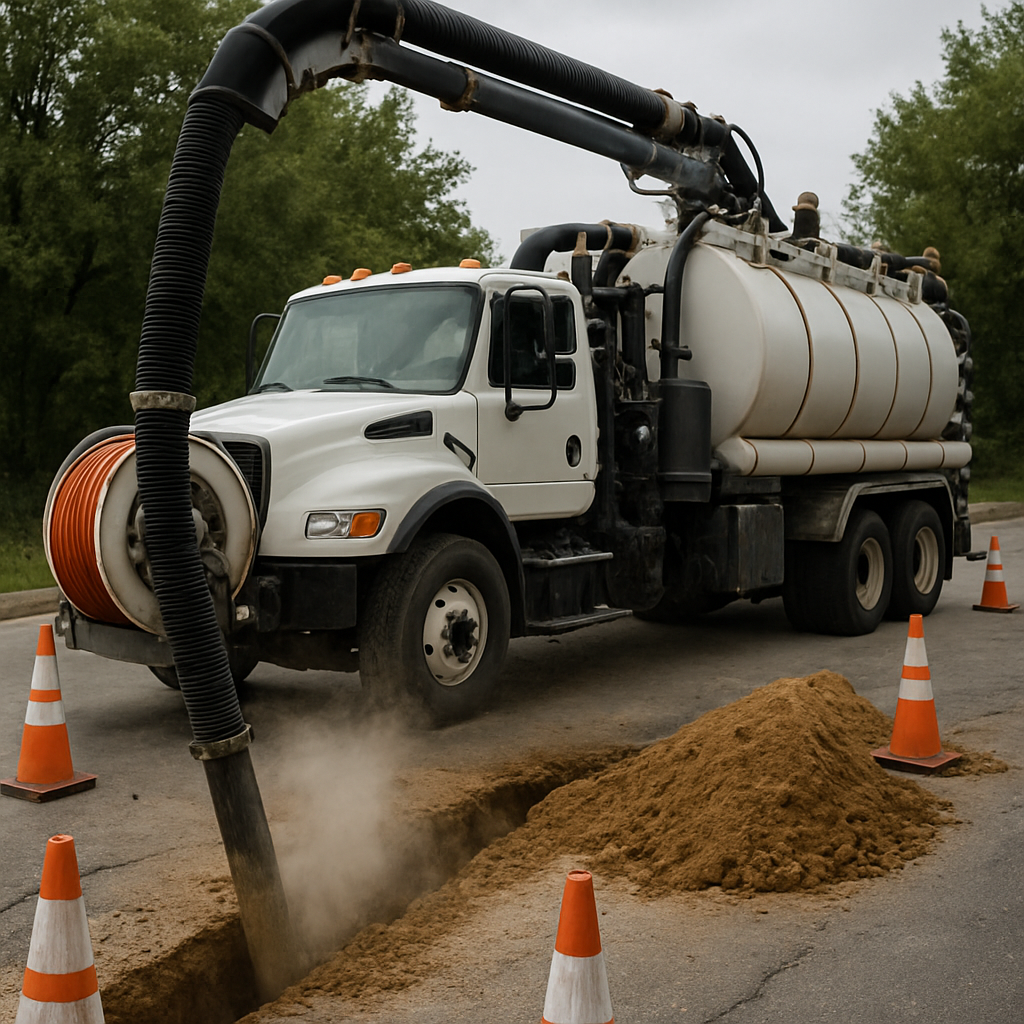
- Large trucks. Big spoil tank, big water tank, serious suction. Built for civil jobs, long service exposure runs, bigger pits and anything where you’d otherwise be emptying every hour. They’re heavy, long and need room.
When the smaller truck wins
A plumber needs to expose the water service and sewer junction at the front of a house in a tight cul-de-sac. Cars parked both sides, a nature strip with a big tree, and the dig is two holes, maybe half a cubic metre between them.
Send the big truck and it can’t turn around. It blocks the street, sits on the verge and leaves ruts in the nature strip. It’s also way more truck than the job needs, and you pay for that.
A small unit pulls up, does both holes, and it’s gone before the neighbours notice.
When you need the big one
A civil contractor is putting in a new conduit run along a road reserve and needs every crossing service exposed along a few hundred metres. That’s dozens of holes, and maybe some slotting too.
Book a small truck for that and you’ll watch it fill up, pack up, drive to the disposal facility, wait in the queue, drive back and set up again. Do that four or five times a day and your crew spends more time standing around than working. The excavator behind it sits idle, waiting for clearance.
The big truck costs more per hour. It also might get the whole thing done in a day and a half instead of three. Do the sums on the whole crew, not just the truck.
When the wrong truck slows everything down
This one happens all the time. A job’s quoted with one size truck, the plan changes, nobody updates the booking, and suddenly the truck on site can’t keep up.
Or it’s the reverse. A big unit gets booked “just in case,” then can’t get within reach of the dig, so the operator runs every metre of hose they’ve got and suction drops right off. Now you’re paying top dollar for a slow dig.
Size the truck to the job you’ve actually got, and ring back if it changes.
Where’s it going to park?
Honestly, this is half the decision.
Before you book, go and stand where the truck will sit and ask yourself a few questions.
Can it physically get there? Think about narrow streets, tight turns, low trees, overhead powerlines, and car park or loading dock height limits. Underground car parks are a classic trap. Plenty of trucks simply won’t fit under the clearance bar.
Can the ground take it? Loaded vac trucks are heavy. Water tank full, spoil tank filling up, they get heavier through the day. Residential driveways, pavers, old concrete and soft verges don’t love that. If the truck has to sit on something you’ll have to fix later, that’s a problem.
How far is the dig from the truck? Hose reach is where tight-access jobs live or die. The truck sits on the street and the hose does the walking, down the side path, through the gate, under the deck. But suction drops off the further you go. Lifting spoil uphill or around a lot of bends makes it worse. A long, steep pull can turn a fast dig into a slow one.
Will you need traffic control or a permit? On a lot of inner-city streets and busy roads, parking a vac truck means a permit and a traffic control plan. Sort that before the day, not on the day.
Give the operator real numbers. “It’s round the back” isn’t useful. “About 35 metres from the kerb, down a side path, maybe a two-metre drop, through a 900 mm gate” is. A decent operator will tell you straight whether their truck can do it, or whether you need a different setup.
Water or air
Most vac work around here is hydro, using pressurised water to cut the soil while the vacuum pulls it out. That’s for good reason. Water gets through clay well, and plenty of our ground is clay.
Air vac uses compressed air instead. It’s slower in heavy clay, but it has a couple of big advantages.
- Dry spoil. You can often backfill straight back into the hole, which cuts down on disposal.
- No slurry to deal with. That’s handy on small residential jobs, or where getting slurry off site is a hassle.
Some trucks can do both. That’s worth asking about if your job has different ground in different spots, or if you want to backfill with what comes out.
Either way, the method has to suit the services. High-pressure water too close to an old poly gas line or brittle cable can do damage. A good operator adjusts pressure and nozzle distance as they go. That’s a skill thing more than a truck thing, but it’s part of the same decision.
Don’t forget the slurry
Slurry is the bit people forget to budget for, and it bites.
Hydro excavation turns dirt into mud. That mud can’t go down the stormwater and it can’t go in a skip. It goes to a licensed facility that charges by volume, and the truck has to drive there and back to drop it off.
So ask:
- Is disposal included in the rate, or charged separately?
- How far is the nearest facility from your site?
- How often will the truck need to empty on this job?
That last one ties straight back to tank size. A small truck on a big hydro job might do three or four disposal runs in a day. That’s a lot of paid hours spent driving instead of digging. Sometimes a bigger truck or an air vac setup works out cheaper overall, even if the hourly rate looks worse.
Wet hire or dry hire
Wet hire means the truck comes with an operator. Dry hire means you get the truck and your crew runs it.
For anything near live services, I’d go wet hire nearly every time. Potholing, footpath work, gas, power, fibre, pressurised water mains. You want someone who’s spent years on the wand and knows when to back off. The truck isn’t what keeps a gas line intact. The bloke holding the lance is.
Dry hire can make sense when:
- Your own crew is properly trained and competent on the gear
- You’ve got a long-running civil job where having the truck on hand all week saves money
- The work is more about spoil removal than precise digging near services
Even then, check what training and tickets the hire company expects. Check who’s responsible for damage, and what’s included for servicing and disposal. Don’t assume.
A few bookings that went sideways
Some I’ve seen, or heard about from people I trust.
The car park. A fit-out job needed a few slots cut in the slab and services exposed underneath, inside a basement car park. A full-size truck was booked. It got as far as the entrance and stopped dead at the height bar. They had to rebook a smaller unit with a long hose run for two days later, and the trades behind them got pushed back.
The backyard tank. A builder booked a big truck for pier holes behind a house on a sloping block. The truck couldn’t get off the street, and the hose run was long and uphill to the truck. It worked, but slowly. A smaller unit closer in, or a different setup, would have done it in half the time.
The “quick” trench. A plumber booked a small unit for “a short trench” that turned out to be 25 metres of sewer line. The truck filled up early and spent the afternoon running back and forth to the disposal facility. It was a two-day job that should have been one.
The dry hire on a gas job. A crew dry hired a truck to save a few hundred bucks and put a junior on the wand near a gas service. They nicked it. Nobody was hurt, but the cost of the gas network callout and the lost day wiped out the saving several times over.
None of those were bad trucks. They were bad matches.
What to tell them when you ring
Here’s what I’d want to hear from a client before I book a truck for them:
- What’s the job? Potholing, trenching, pier holes, pits, service exposure, spoil removal.
- Roughly how much dirt? Number of holes and size, or trench length, width and depth.
- What services are in the area? Send the Before You Dig Australia plans if you’ve got them, plus any locator marks or reports.
- Where will the truck park, and how far is the dig? Include distance, slope, gates, height limits and ground conditions.
- What’s the ground like? Clay, sand, fill, rock close to the surface.
- Wet or air, and do you want to backfill with the spoil?
- Wet hire or dry hire?
- Any permits, traffic control or site rules? Things like induction requirements and working hours.
Then ask them one question back. What truck would you send, and why?
If they can’t explain why, or they just say “whatever’s free,” keep ringing. A good operator will match the truck to the job. Sometimes they’ll even tell you that you need less than you asked for, and those are usually the people worth booking.
The short version
There’s no single best vac truck. There’s the right one for your site, your dirt and your services.
Small and nimble for tight residential work and a few careful holes. Bigger units for long runs, civil jobs and anything where you’d otherwise spend half the day driving to the tip. Wet hire when there’s anything live nearby. Air vac when you want to keep the spoil and skip the slurry.
Before you book, walk the site. Measure the gate, look at where the truck has to park, and work out how much dirt is really coming out. Ten minutes of that will save you a day of standing around watching the wrong truck struggle.